
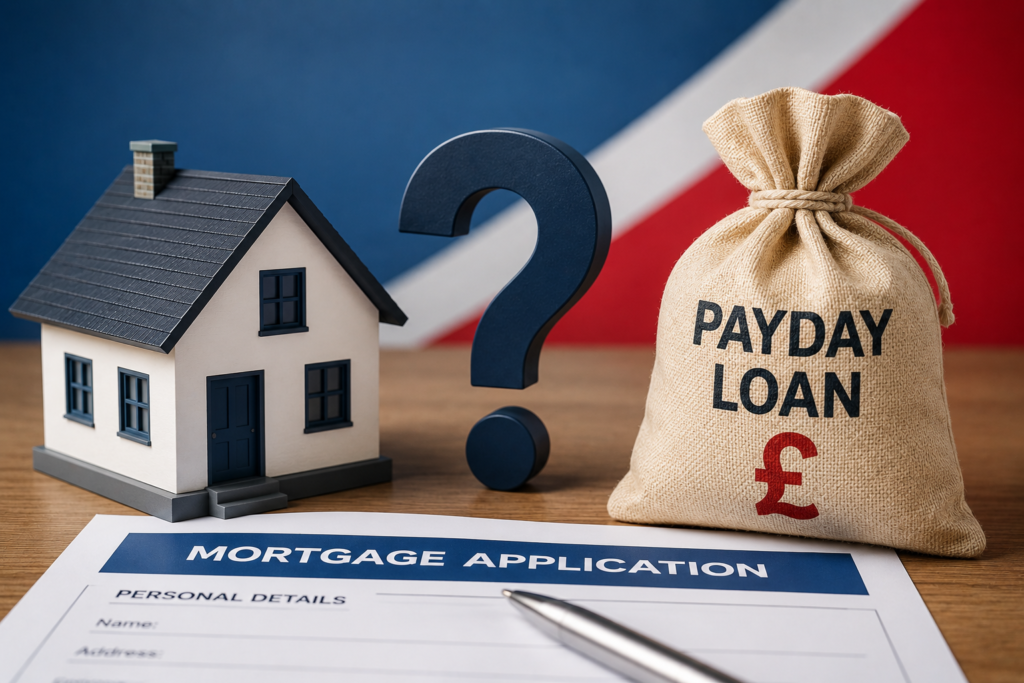
Payday loans can affect a mortgage application in the UK, even when they have been repaid on time.
Mortgage lenders assess more than your income and deposit. They may review your credit history, recent borrowing, current debts, bank statements and monthly expenditure to decide whether the proposed mortgage is affordable.
A payday loan on your credit report can indicate that you previously needed short-term borrowing to manage a cash-flow shortage. Some mortgage lenders may view this as evidence of financial pressure, while others may consider the wider circumstances, including how long ago the loan was used and whether it was repaid correctly.
Having used a payday loan does not automatically prevent you from getting a mortgage. However, it can reduce your lender options and may make the application more difficult.
This guide explains:
- What payday loans are
- How payday loans appear on your credit report
- How mortgage lenders may assess them
- The difference between occasional and repeated payday borrowing
- How they could affect residential and buy-to-let applications
- Practical steps to take before applying for a mortgage
What Is a Payday Loan?
A payday loan is a form of high-cost short-term credit.
It is generally designed to provide a relatively small amount of money for a short period, traditionally until the borrower’s next payday. Some modern short-term loans are repaid through several instalments rather than one payment.
Payday loans normally carry high borrowing costs compared with many mainstream credit products. The Financial Conduct Authority regulates high-cost short-term credit and applies rules covering matters such as affordability checks, charges, rollovers and payment collection.
People may use payday loans to cover:
- Emergency repairs
- Unexpected household bills
- Temporary income shortages
- Essential travel expenses
- Costs arising before their next salary payment
The main concern is that short repayment periods and high costs can make the debt difficult to manage, particularly when the borrower is already struggling with other commitments.
Do Payday Loans Appear on Your Credit Report?
Payday loans are normally recorded on your credit file.
A mortgage lender may therefore be able to see that you have used payday lending when it reviews your credit history.
The report may show information such as:
- The lender’s name
- The date the account was opened
- The amount borrowed
- The account balance
- Whether payments were made on time
- Whether the account was settled
- Any missed payments or defaults
MoneyHelper states that payday loans can remain on a credit file for six years. Their effect will depend partly on whether they were repaid on time and in full.
Can Payday Loans Affect a Mortgage Application?
Yes. Payday loans can affect a mortgage application, but the outcome depends on the circumstances and the lender’s individual criteria.
Some mortgage lenders may view any payday-loan usage negatively because it can suggest that the applicant previously struggled to cover normal expenses without emergency borrowing.
Other lenders may distinguish between:
- One historic payday loan
- Several payday loans used over a short period
- Repeated payday borrowing over several years
- Loans repaid on time
- Loans with missed payments
- Outstanding payday-loan balances
- Defaults arising from payday loans
MoneyHelper warns that some mortgage providers will not offer a mortgage where payday loans appear on the credit file, while others assess how frequently the loans were used and how long ago the most recent one occurred.
There is no universal policy followed by every lender.
How Mortgage Lenders May Assess Payday Loans
Mortgage lenders do not normally consider payday-loan usage in isolation.
They may assess the complete financial picture, including income, expenditure, deposit, debts, employment and recent account conduct. Mortgage affordability assessments generally examine both what you earn and what you regularly spend.
| Assessment factor | What the lender may review | Why it matters |
|---|---|---|
| Number of payday loans | Whether you used one loan or relied on them repeatedly | Repeated borrowing may indicate ongoing cash-flow difficulties. |
| Date of the most recent loan | How much time has passed since the last payday loan | Recent use may concern lenders more than historic borrowing. |
| Repayment history | Whether payments were made on time and in full | Missed payments can indicate difficulty managing credit. |
| Outstanding balance | Whether any payday debt remains unpaid | Current debts affect both credit risk and affordability. |
| Defaults or arrears | Whether a payday loan resulted in adverse-credit markers | Defaults can restrict the number of suitable lenders. |
| Reason for borrowing | Whether the loan covered an isolated emergency or regular living costs | The lender may consider whether the difficulty was temporary or ongoing. |
| Income stability | Your employment, earnings and income history | Stable income can support the affordability assessment. |
| Existing commitments | Credit cards, loans, car finance and other debts | Higher monthly commitments reduce disposable income. |
| Bank-statement conduct | Overdraft use, returned payments and regular spending | Statements help lenders verify whether the mortgage appears manageable. |
| Deposit | The amount you are contributing to the property purchase | A larger deposit may reduce the lender’s loan-to-value exposure. |
One Payday Loan Versus Repeated Borrowing
The frequency of payday-loan usage can make a significant difference.
One Historic Payday Loan
A single payday loan used several years ago for an unexpected expense may be viewed less seriously where:
- It was repaid on time
- No further payday loans were used
- No missed payments or defaults occurred
- Your recent credit conduct is stable
- Your current income and expenditure are manageable
This does not guarantee mortgage approval, but some lenders may be prepared to consider the application.
Repeated Payday Loans
Repeated borrowing can create greater concern.
It may suggest that the applicant:
- Regularly ran out of money before payday
- Used new borrowing to manage existing commitments
- Had insufficient emergency savings
- Experienced ongoing affordability problems
- Relied on high-cost credit for normal expenses
The FCA’s research has historically found that payday-loan borrowers were more likely than the wider UK adult population to experience over-indebtedness and low confidence in managing money. Mortgage lenders can therefore treat repeated payday borrowing as a risk indicator.
Payday Loans With Missed Payments
The application can become more difficult when payday-loan repayments were missed.
Missed payments may:
- Damage your credit profile
- Lead to arrears
- Result in a default
- Increase the outstanding balance
- Suggest that the loan was unaffordable
- Reduce the number of mortgage lenders available
The lender will normally examine both the payday-loan usage and the resulting adverse-credit record.
How Long Do Payday Loans Affect Mortgage Applications?
Payday loans can remain on a credit file for six years.
However, this does not mean every applicant must automatically wait six years before applying for a mortgage.
Some lenders may consider an application sooner, depending on:
- How long ago the loan was taken
- How many payday loans were used
- Whether they were repaid on time
- Whether any adverse credit resulted
- Your recent credit history
- Your deposit
- Your income and affordability
- The lender’s internal criteria
Your options may improve as more time passes without further payday borrowing or missed payments.
MoneyHelper states that mortgage prospects can improve once six years have passed since the most recent payday loan because the record should no longer appear on the standard credit file.
Does Repaying a Payday Loan on Time Help?
Repaying a payday loan on time is better than missing payments, but it does not necessarily remove the mortgage concern.
A mortgage lender may still see that you used high-cost short-term credit and question why the borrowing was needed.
Paying on time may demonstrate that:
- You met the agreed repayment
- The account did not fall into arrears
- No default resulted
- The balance has been cleared
However, some lenders may still decline the application because payday borrowing can indicate previous cash-flow pressure.
This is why the age and frequency of the borrowing can matter as much as its repayment status.
How Payday Loans Affect Residential Mortgages
A residential mortgage is used to buy or remortgage the home in which you intend to live.
When assessing a residential mortgage application involving payday loans, the lender may consider:
- Your credit report
- Your recent bank statements
- Your income
- Your employment security
- Your regular household costs
- Current debt repayments
- The number and age of payday loans
- Whether they were settled
- Your available deposit
- The property’s value and condition
Some mainstream lenders may decline applications where payday loans have been used recently.
Other lenders, including certain specialist mortgage providers, may consider the application where the borrowing was historic, limited and followed by stable financial conduct.
The available mortgage may have:
- A higher interest rate
- A larger deposit requirement
- Higher product fees
- A lower maximum loan-to-value
- Additional evidence requirements
These outcomes depend on the lender and are not automatic.
How Payday Loans Affect Buy-to-Let Mortgages
A buy-to-let application may also be affected by payday-loan usage.
Although buy-to-let affordability is heavily influenced by the property’s expected rental income, lenders can still assess the applicant’s personal credit history and wider financial position.
They may review:
- Personal payday-loan history
- Defaults or arrears
- Existing residential mortgage conduct
- Current personal debts
- Deposit size
- Expected monthly rent
- Rental coverage calculations
- Property type
- Landlord experience
- Personal income, where required
A lender may question whether repeated high-cost borrowing indicates difficulty managing personal finances or property-related commitments.
Not all buy-to-let mortgages are regulated by the Financial Conduct Authority.
Fixed and Variable Mortgages After Payday Loans
Payday-loan usage does not directly determine whether you must choose a fixed or variable mortgage.
The rate types available will depend on the products offered by lenders willing to consider your application.
Fixed-Rate Mortgage
A fixed-rate mortgage keeps the interest rate unchanged for an agreed period.
Potential benefits include:
- Predictable monthly repayments
- Greater budgeting certainty
- Protection from rate increases during the fixed period
You should also consider:
- Product fees
- Early repayment charges
- Overpayment restrictions
- The rate after the fixed period ends
Variable-Rate Mortgage
A variable mortgage rate can increase or decrease.
Variable-rate products may include:
- Tracker mortgages
- Discounted variable rates
- Standard variable rates
The initial rate may sometimes appear lower, but repayments can rise.
The appropriate mortgage should be chosen according to total cost, affordability, flexibility and personal circumstances—not solely because of previous payday borrowing.
Illustrative Example: One Historic Payday Loan
John used a payday loan several years ago to pay for an urgent car repair.
He:
- Repaid the loan on time
- Did not use another payday loan
- Maintained all other payments
- Built an emergency savings fund
- Continued in stable employment
- Saved an appropriate mortgage deposit
Before applying for a residential mortgage, John checked his credit reports and discussed the borrowing with a mortgage adviser.
The adviser identified a lender whose criteria allowed the historic payday loan to be considered as part of the wider application.
The application proceeded to full affordability checks and property valuation.
This example is illustrative only. It does not guarantee that another applicant in similar circumstances will be approved.
Illustrative Example: Repeated Payday Borrowing
Sarah used several payday loans during a period of unstable income.
Some repayments were missed, and one account was later recorded as defaulted.
When Sarah considered applying for a mortgage, her credit reports showed:
- Multiple payday-loan accounts
- Recent borrowing
- Missed payments
- An outstanding default
- Other existing debt commitments
An adviser explained that submitting an immediate mortgage application could lead to a decline.
Sarah focused on stabilising her income, obtaining debt advice, resolving outstanding balances where appropriate and avoiding further missed payments before reviewing her mortgage position again.
This example demonstrates why repeated or unpaid payday borrowing can have a more serious effect than one historic, correctly repaid loan.
How to Improve Your Mortgage Application After Payday Loans
1. Check All Three Credit Reports
Check your credit information with:
- Experian
- Equifax
- TransUnion
Your reports may not contain exactly the same information.
Review:
- Payday-loan account dates
- Balances
- Repayment records
- Settled status
- Defaults
- Recent credit searches
- Address history
- Financial associations
- Accounts you do not recognise
Checking your own report does not damage your credit rating because it is treated as a soft search.
2. Correct Inaccurate Information
If a payday loan is recorded incorrectly, contact both:
- The credit reference agency
- The lender that supplied the information
You may need to provide:
- Payment receipts
- Bank statements
- Account correspondence
- Settlement confirmation
- Identity-fraud evidence
Do not assume that a genuine payday loan can be removed simply because it was repaid. Accurate records will normally remain for the relevant reporting period.
3. Clear Outstanding Payday Loans Where Appropriate
An unpaid payday loan can affect affordability and credit assessment.
Where financially appropriate, resolving the balance may strengthen your position.
Before making payments:
- Confirm the amount owed
- Verify who owns or collects the debt
- Request written settlement information
- Keep proof of payment
- Check that your credit report is updated
Seek free regulated debt advice where you cannot afford the repayments or are relying on further borrowing to manage them.
4. Stop Using Payday Loans Before Applying
Further payday borrowing shortly before a mortgage application may indicate that your finances are not yet stable.
Focus on creating a position where regular costs can be covered without short-term high-cost credit.
This may involve:
- Reviewing household spending
- Reducing non-essential commitments
- Building emergency savings
- Adjusting debt repayments
- Checking entitlement to financial support
- Seeking debt advice
5. Build Stable Financial Conduct
Maintain all current payments, including:
- Rent
- Existing mortgage payments
- Credit cards
- Personal loans
- Car finance
- Mobile phone contracts
- Utility bills
- Council Tax
A period of stable payment behaviour can help demonstrate that the original financial difficulty has ended.
6. Reduce Existing Debt
Mortgage lenders assess regular outgoings, including credit cards and other financial commitments. Higher debt repayments can reduce the mortgage amount considered affordable.
Where practical, consider reducing:
- Credit-card balances
- Overdraft usage
- Personal loans
- Catalogue debts
- Buy-now-pay-later commitments
- Other short-term borrowing
Do not use all your savings to clear debt without keeping enough for fees, emergencies and the mortgage deposit.
7. Save a Larger Deposit
A larger deposit can reduce the percentage of the property price being borrowed.
This may:
- Increase the number of potential mortgage products
- Reduce monthly repayments
- Lower the lender’s loan-to-value exposure
- Strengthen the overall application
Most standard mortgages require a deposit, and the size of the deposit can affect the products and costs available.
A larger deposit does not guarantee approval where the lender’s payday-loan criteria are not met.
8. Keep Bank Statements Stable
Lenders may request several months of current-account statements.
MoneyHelper identifies bank statements, payslips, tax documents and proof of deposit among the evidence commonly required during a mortgage application.
Before applying, try to avoid:
- Returned direct debits
- Unpaid fees
- Persistent unauthorised overdraft use
- New payday loans
- Undisclosed credit commitments
- Spending that makes the mortgage appear unaffordable
The objective is not to create artificially perfect statements. It is to demonstrate a sustainable financial position.
9. Avoid Multiple Credit Applications
Every full application for credit can create a hard search.
A large number of hard searches over a short period can make lenders think that you are relying heavily on credit. Hard searches can remain visible on a credit report for up to two years.
Avoid applying simultaneously for:
- Personal loans
- Credit cards
- Car finance
- Payday loans
- Several mortgage agreements
Check eligibility and lender criteria before making a full application.
10. Prepare a Clear Explanation
A mortgage lender or underwriter may ask why the payday loan was used.
A useful explanation should cover:
- When the loan was taken
- Why the borrowing was needed
- Whether it was an isolated event
- When it was repaid
- Whether further payday loans were used
- What has changed since
- How your current finances are managed
Keep the explanation honest, concise and supported by evidence where necessary.
11. Speak to a Mortgage Adviser
A mortgage adviser experienced in complex-credit cases may help you:
- Review your credit reports
- Identify how lenders may view the payday loans
- Check whether enough time has passed
- Compare mainstream and specialist criteria
- Assess deposit requirements
- Prepare your supporting documents
- Avoid unsuitable mortgage applications
- Compare rates, fees and conditions
MoneyHelper specifically recommends speaking to a mortgage adviser because not all lenders automatically decline applicants who have previously used payday loans.
An adviser cannot guarantee mortgage approval.
What Documents Might Be Required?
Prepare documents such as:
- Proof of identity
- Proof of address
- Recent payslips
- P60
- Bank statements
- Evidence of deposit
- Details of existing debts
- Self-employed accounts
- Tax calculations
- Tax year overviews
- Payday-loan settlement records
- A written explanation of the borrowing
The exact requirements will depend on the lender, employment type and application.
Common Mistakes to Avoid
Avoid:
- Applying without checking your credit reports
- Assuming a repaid payday loan cannot affect the application
- Taking another payday loan shortly before applying
- Submitting applications to several mortgage lenders at once
- Hiding previous borrowing
- Ignoring outstanding balances
- Borrowing the mortgage deposit without disclosing it
- Focusing only on your credit score
- Assuming a larger deposit guarantees approval
- Using an unregulated credit-repair company
What If Your Mortgage Application Is Declined?
Do not immediately apply to another lender.
Each application may leave another search on your credit file, and repeated applications can make the situation more difficult.
MoneyHelper recommends identifying the reason for a mortgage decline before submitting another application. Common reasons can include credit history, excessive debt and employment concerns.
Consider:
- Asking whether the lender can provide feedback
- Checking which credit reference agency was used
- Reviewing your credit reports
- Correcting inaccurate information
- Allowing more time since the payday loan
- Reducing debts
- Increasing your deposit
- Improving recent financial conduct
- Speaking to an experienced mortgage adviser
Frequently Asked Questions
Can I get a mortgage if I have used one payday loan?
Possibly.
One historic payday loan that was repaid correctly may be accepted by some lenders, particularly when there has been no further adverse credit.
Other lenders may still decline because of their internal policy.
Can I get a mortgage with a recent payday loan?
It can be more difficult.
Recent payday borrowing may indicate current cash-flow pressure. Some lenders may require a period without payday-loan usage before considering the application.
Can I get a mortgage with an unpaid payday loan?
Options may be very limited.
An outstanding payday loan affects both the credit assessment and monthly affordability. The lender may also be concerned that you are currently struggling with financial commitments.
Will a repaid payday loan disappear immediately?
No.
Repaying the loan should update the account balance and status, but the record can remain visible on your credit file for six years.
Can a payday loan reduce my credit score?
Applying for a payday loan can create a hard search, which may temporarily affect your credit score.
Missed or late repayments can cause more significant damage to your credit profile.
Will every mortgage lender reject payday loans?
No.
Some lenders may reject any application involving payday loans, while others consider the frequency, age and repayment history.
Is a payday loan worse than an overdraft?
Mortgage lenders assess different types of borrowing according to their own criteria.
Repeated payday borrowing and persistent overdraft use can both indicate financial pressure. The lender will consider the wider pattern rather than relying only on the product name.
Can a larger deposit overcome payday-loan history?
A larger deposit may strengthen the application, but it does not override the lender’s credit criteria.
The application must still pass affordability, eligibility and property checks.
Can I get a buy-to-let mortgage after using payday loans?
Potentially.
The lender may assess your personal credit record, deposit, expected rent and existing commitments. Recent or repeated payday borrowing may limit the lenders available.
Should I wait six years before applying?
Not necessarily.
Some lenders may consider an application before the payday loan disappears from your credit report.
The correct timing depends on the loan’s age, frequency, repayment history, your current finances and the lender’s criteria.
Summary: Payday Loans and Mortgage Applications
Payday loans can affect your mortgage application because they are visible on your credit report and may indicate previous financial pressure.
The key points are:
- Payday loans can remain on your credit file for six years.
- Some mortgage lenders will decline applications involving payday loans.
- Other lenders assess how frequently and recently they were used.
- A repaid payday loan can still affect the application.
- Missed payments, defaults and outstanding balances create greater concern.
- Repeated payday borrowing is generally more difficult than one isolated historic loan.
- Lenders assess income, debts, expenditure, deposit and bank statements as well as credit history.
- A larger deposit may help but does not guarantee approval.
- Avoid repeated mortgage or credit applications.
- An experienced mortgage adviser can help identify potentially suitable lenders.
Every mortgage application is assessed individually. Availability, interest rates and deposit requirements depend on your circumstances and the lender’s criteria at the time.
Ready to Discuss Your Mortgage Options?
If you have previously used payday loans and are unsure how they could affect your mortgage application, BSL Financials can help you understand your position.
Our advisers can review your circumstances, explain the possible residential or buy-to-let mortgage routes and help you prepare an application for a lender whose criteria may be suitable.
Contact BSL Financials today for a no-obligation discussion about your mortgage options.
Disclaimer: This article is for general information only and does not constitute regulated financial or debt advice. Mortgage availability, rates and lender criteria depend on individual circumstances and may change. Speak to a qualified mortgage adviser for personalised advice. Seek free regulated debt advice if you are struggling with borrowing or repayments. Your property may be repossessed if you do not keep up repayments on your mortgage. Not all buy-to-let mortgages are regulated by the Financial Conduct Authority.